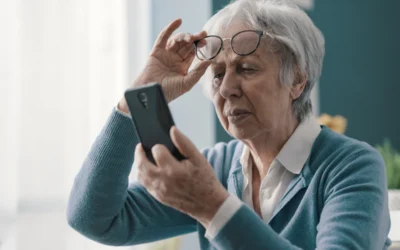
Presbyopia can feel like it shows up overnight. One day, you’re reading a menu with ease, and the next, you’re holding it at arm’s length under the brightest light you can find.
If you’ve been nearsighted for years and relied on glasses to see far away, this shift can be especially confusing. Your distant vision may seem familiar, but close-up tasks suddenly take more effort. We talk with people every week who simply want their eyes to feel “easy” again.
What is presbyopia?
Presbyopia is an age-related focusing change that typically starts in your 40s. Inside your eye, the natural lens and the tiny muscles change shape gradually and lose flexibility. That flexibility is what allows you to focus up close on your phone, a book, a recipe, or your laptop.
As that focusing system stiffens, your near vision becomes less crisp. You may notice:
- You need brighter light to read comfortably
- Print looks blurry up close but clear when you hold it farther away
- Your eyes feel tired sooner during close work
- Headaches or eye strain after reading or screen time
Presbyopia isn’t an eye disease. It’s a normal change, but the day-to-day impact can be very real.
Why vision changes after 40
Many people adapt to vision changes without realizing it by squinting a bit, increasing font size, leaning closer, then backing away. Eventually, those “little adjustments” stop working, and the shift feels abrupt.
A few reasons it gets more noticeable in your 40s:
- Your focusing range narrows year by year
- Screens demand sustained near focus (often for hours)
- Dryness can increase with age and make vision fluctuate
- Lighting conditions (restaurants, dim bedrooms) highlight focusing problems
If you’ve had myopia (nearsightedness) most of your life, presbyopia can create a strange mix: distance may still be blurry without correction, while near vision may start to blur even with your usual correction.
Presbyopia vs. myopia: what’s the difference?
It helps to separate these two, because they’re often talked about together:
- Myopia (nearsightedness): a distance-vision issue related to the eye’s shape/length
- Presbyopia: a near-vision focusing issue related to the lens losing flexibility
You can have one, the other, or both. And if you already wear glasses or contact lenses, presbyopia often means your prescription needs a new strategy, not just “stronger lenses.”
Everyday options for changing vision
Presbyopia treatment is personal and will vary depending on the patient. A successful plan will consider how you spend your time: driving, screens, reading, sports, detailed work, or a little of everything.
Common solutions include:
- Reading glasses for close-up tasks (simple and effective)
- Multifocal glasses that blend distance and near correction
- Contact lenses
- Multifocal contacts for both near and far
- Monovision (one eye optimized for distance, the other for near)
- Prescription eye drops to improve near focus in the short term
- Lifestyle tweaks that reduce strain, like better lighting and intentional breaks
Can LASIK fix presbyopia?
LASIK can reduce dependence on glasses for many patients, and some explore it as part of a presbyopia plan (often using monovision or blended-vision approaches). Whether it’s a good option for you depends on your eyes, your prescription, your work, your hobbies, and how you feel about crispness at different distances.
Presbyopia isn’t one-size-fits-all. Some people prioritize night driving clarity; others prioritize reading comfort; many want a balance that feels natural. A thoughtful evaluation is key to finding the best options for your future visual health.
Clearer near vision, less effort, more freedom
If you’re noticing the “long-arm reading pose,” fighting with tiny text, or feeling drained after screens, a presbyopia-focused exam can turn guesswork into a plan that matches your life. Schedule an appointment with Clarin Eye Care Center in Palmetto Bay or Coral Gables Eye Care in Coral Gables to explore options that help you read, work, and relax comfortably again.